Last week, I headed to Saarbrücken, Germany for the ELLIS TRAID Summer School. It was a great week packed with talks and workshops on trustworthy AI in drug discovery. As we rely more on AI to find new drugs, figuring out how to make these models interpretable and robust is getting pretty crucial.
A topic that I found particularly interesting was data splitting for molecular machine learning, which is not as trivial as it seems. In the field, we often deal with highly correlated subsets, and standard random splits almost guarantee data leakage and false results.
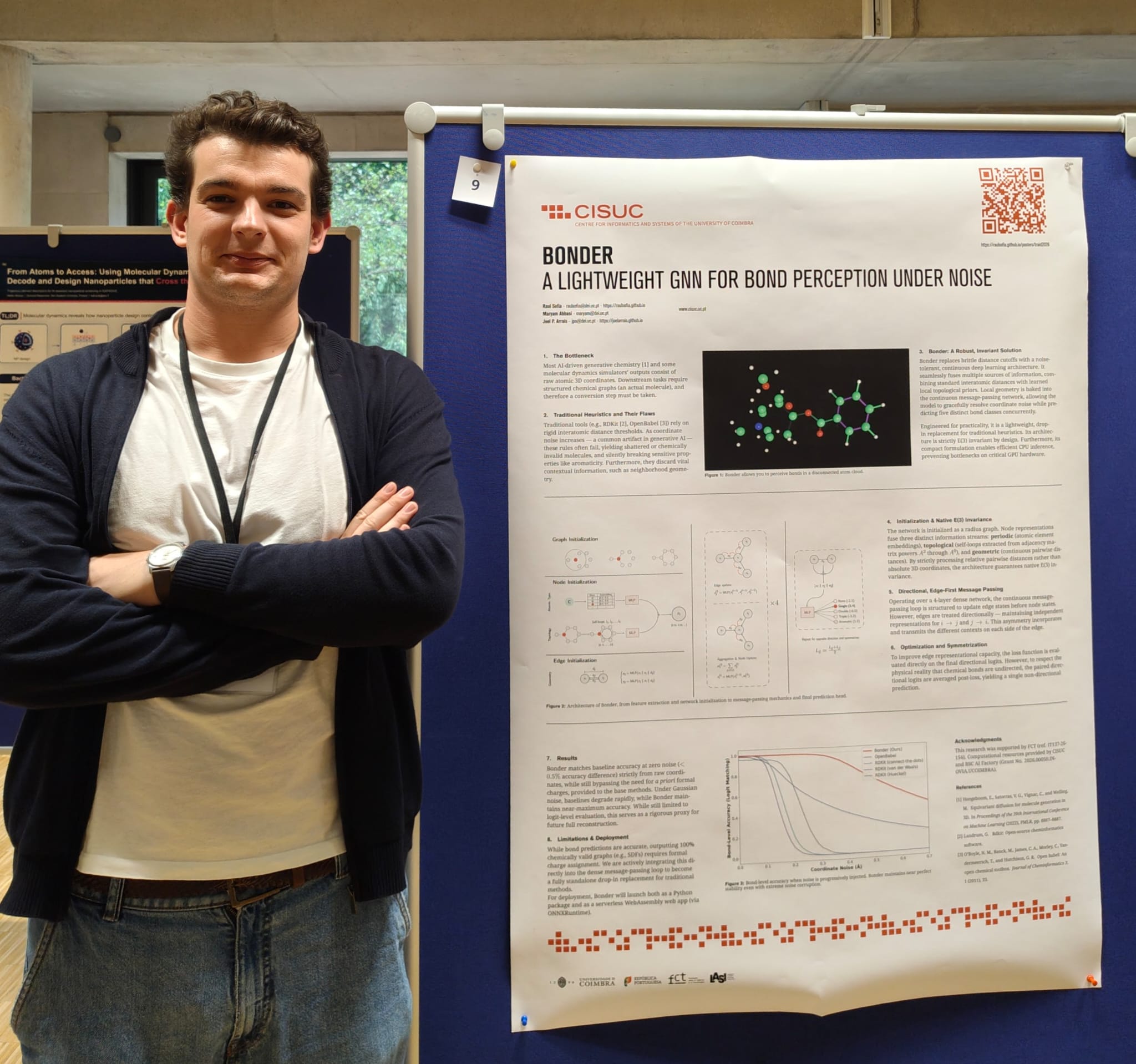
Outside the main lectures, I also brought a poster to share some of my own ongoing work. I presented Bonder, an E(3)-invariant graph neural network I’ve been building to reconstruct molecules directly from 3D atomic clouds, predicting bond orders and formal charges. It was a project that branched out from my Master’s thesis, after I noticed that standard tools like RDKit or OpenBabel struggled to reconstruct subtle features like aromatic rings, particularly when noise was present, as in any generative scenario. Later, I found out that there were other use cases for it in domains like Molecular Dynamics, so I decided to extract it as a standalone project.
I was happy to hear that other attendees of the Summer School found uses for it in their own fields, and I got some useful feedback on tailoring it.
It is still a work in progress, but you can check out the poster and related materials here. More updates on the model are coming soon.